
Read the Osage County Owner-of-Record Card
Start with the Appraiser parcel search. You can query by owner name, address, parcel, legal description, acreage, class, construction, or value. The selected parcel card then shows the owner-of-record details.
| Owner of Record | The roll's current owner display |
|---|---|
| Parcel Keys | Parcel ID and Quick Ref ID |
| Mailing Address | A notice route, not proof of occupancy |
| Situs Address | The physical property location |
| Legal Description | The land key used at the Register |
| Deed Reference | Confirm through the newest recorded instrument |
The owner of record need not live on the land. Mailing data routes tax notices, situs identifies the physical tract, and company or trust names may stand in for an individual.
Check Osage Owner Data After Tuesday
The Appraiser's parcel page updates every Tuesday. Record the day and time of any current-owner search. A recent closing or correction may not surface until a later refresh, and a deed recorded midweek can easily outrun the roll. The portal also separates current-year appraised values from tax information, which rests on a prior assessed value.
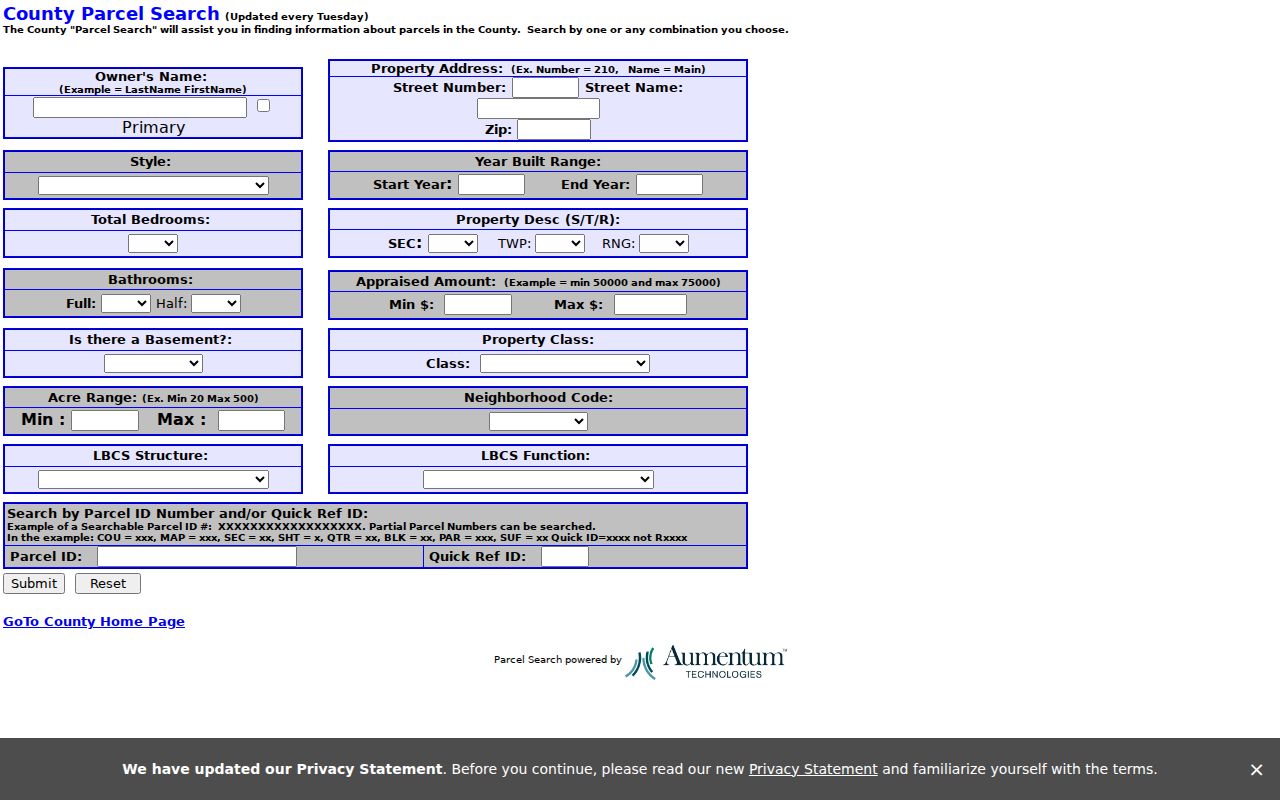
The search identifies the parcel; it does not replace the latest deed.
Request the Latest Osage Deed Offline
The Register of Deeds wants a party name, the legal description, and sometimes an address. Phone, fax, mail, and email all reach the office. So does the counter at 717 Topeka Avenue in Lyndon. Recording service ends at 3:30 p.m. That is earlier than general office closing. Request the newest deed with the grantee and recording date. Include the deed type, instrument or book-and-page reference, and any prior reference. Copy and certification fees are published; title searches are not offered.
Interpret an Osage Company Owner
An LLC on the roll has a paper trail. Run the name through the Kansas Secretary of State Business Entity Search. The record may list filings and a registered agent. That agent is not automatically the landowner or the company's beneficial owner.
A trust may lawfully hide its beneficiaries. An estate may need a Fourth Judicial District probate file. The probate then produces a recorded transfer. Match the exact entity name and legal description rather than a similar mailing address.
Confirm the Current Osage County Owner
The Appraiser refreshes its search every Tuesday. A deed can therefore be newer than the visible roll, and while the county posts Register of Deeds instructions and fees, it publishes no public deed-index screen.
- Find the parcel by situs address and record the search date.
- Save the owner name, parcel keys, and legal description.
- Ask the Register for the newest deed for that land.
- Compare its grantee and recording date with the roll.
- Owner of record
- The party displayed on the assessment roll.
- Vesting
- How a recorded instrument states that title is held.
- Recording lag
- The gap between deed recording and a roll refresh.
Distinguish Osage Situs from Owner Mail
Situs is where the property sits. The mailing address is where the owner receives notices. It may be states away. A remote mailing address is not a data error, and a shared mailing address does not prove two parcels share one title.
The detail route links to a sketch, property image, GIS map, search page, and home screen. Not every selected card shows every owner, mailing, sale, and value field. Treat any field it omits as unknown.
Use All Current-Owner Access Routes
The portal is not the only route. The Appraiser takes phone, fax, and in-person requests. The Register offers mail, email, phone, fax, and counter service for the newest deed. The Treasurer's portal and office cross-check the tax account. A specific KORA request can seek an existing county record in a stated format.
The Kansas Open Records Act allows reasonable actual-cost fees. It never requires staff to compile a new list. For a wider address-to-owner method, see who owns an Osage County property.
Note: A roll name is a navigation clue; a deed is dated evidence, and neither alone supplies a legal title opinion.
Check Osage Current Owner Conflicts
A conflict starts with dates. Write down when you viewed the Appraiser result. Then obtain the newest deed's recording date. If the deed is later, its grantee may reflect a transfer that has not reached the next Tuesday parcel refresh. A tax account can lag for a different reason because it may rest on a prior assessed value.
Next, compare the land keys. The deed's legal description must cover the same tract as the parcel result. Match the Parcel ID or Quick Ref ID where the county record provides them. Never rely on a shared mailing address. A multi-tract deed may need separate parcel checks.
If the owner of record is a personal representative, trustee, or company, preserve that capacity exactly as written. Kansas business records may confirm an entity exists. They do not prove who benefits from its land, and court or probate files may explain transfer authority subject to public-access limits.
Save the Osage Owner Card Fields
A reproducible owner check saves more than a name. Record the situs, mailing address, parcel and Quick Ref identifiers, legal description, class, and displayed valuation year. Also note which fields your result actually shows. Selected cards do not all display every possible detail. Keep the search date and the newest deed citation too. Another reviewer will thank you. They can then tell whether a difference came from a new transfer, a corrected roll, or a search against the wrong tract.
Use Osage Owner Addresses with Restraint
A published mailing address shows where notices go, not who lives there. It may differ from the situs address entirely. Treat it as a routing detail rather than proof of occupancy. Resist any urge to use it for contact beyond legitimate record business. Kansas offers real protections here. Safe at Home gives qualifying participants a substitute address, and K.S.A. 45-230 bars commercial use of public lists of names and addresses.
Lawful use. Use a public owner address only for a legitimate property matter. Never use it to harass, intimidate, or harm anyone.