
Reconstruct Osage County's Prior Owner Timeline
The chain always begins at the newest deed. Name the current parcel, then track each grantor back to the instrument by which that same person or entity first acquired the land. Exact legal descriptions keep similarly named people from drifting into the wrong line of former property owners.
| Source | Years It Covers | Where Held | What It Shows |
|---|---|---|---|
| Recorded deeds | Early 1800s to present reported | Register of Deeds | Grantors, grantees and land |
| KSHS county archive | 1858-1954 | Kansas Historical Society | Deeds, mortgages and court context |
| Ownership atlases | 1879, 1899, 1918 | KSHS | Historic land labels and owners |
| Will microfilm | 1861-1922 | KSHS | Estate clues across a transfer |
Recorded instruments from the Register hold the chain together. Archives, plats, wills, and newspapers add context around a name change or a puzzling stretch of years, but they never take the place of the deeds themselves.
Start With Osage Legal Descriptions
A street address is only a starting clue. The Register asks for a full legal description before any sound property search can run. City land usually sits in an addition, block, and lot. Rural land runs on section, township, and range. Keep that wording exactly as written while the chain moves backward. Road names, house numbers, and mailing cities shift. The land description stays stable.
The Appraiser's property search accepts address fragments, Parcel ID, Quick Ref ID, and section-township-range. Use whichever tool fits to convert a known address into that durable land key. Two former owners sometimes shared a name. The legal description separates the right deed from an unrelated one.
Document Each Osage Ownership Transfer
Keep a working timeline with one row per transfer. For every deed, log the recording date, grantor, grantee, and deed type. Also record the book-page or instrument number. Warranty and quitclaim deeds both convey an interest. The type alone says little about title quality. Watch for a prior-reference clause, which can hand you the next older link directly.
| Transfer Date | Grantor to Grantee | Deed Type | Book or Page |
|---|---|---|---|
| Newest recorded date | Seller to current grantee | As written | Exact citation |
| Next earlier date | Prior owner to seller | As written | Exact citation |
| Continue backward | Earlier parties | As written | Exact citation |
Never fill a gap by guessing. A probate case, sheriff's deed, name variant, or entity transfer often explains why the next link is not an ordinary sale.
Osage Deed Access Is Offline
Osage County publishes Register contact and fee information. But the office offers no public online grantor-grantee index. That does not mean any year is missing. It simply means deed records requests go through phone, fax, mail, email, or the Lyndon counter. There, staff check existing indexes and deed books for you.
Give staff a narrow name range, the legal description, and an approximate date. Records reportedly reach into the early 1800s. Older searches take time, though, and the Register does not perform title work. Certified and plain copies are both available under the posted fee schedule. When the answer must back a legal opinion, a title professional is the right route.
Osage Atlases Preserve Owner Snapshots
The Kansas Historical Society ownership-map finding aid lists Osage County atlases from 1879, 1899, and 1918. These plat maps can pin a surname to land. They can also surface an addition name, or show a large tract splitting apart. Treat them as snapshots, not as a continuous deed chain.
The official finding aid page displays the available Osage years.
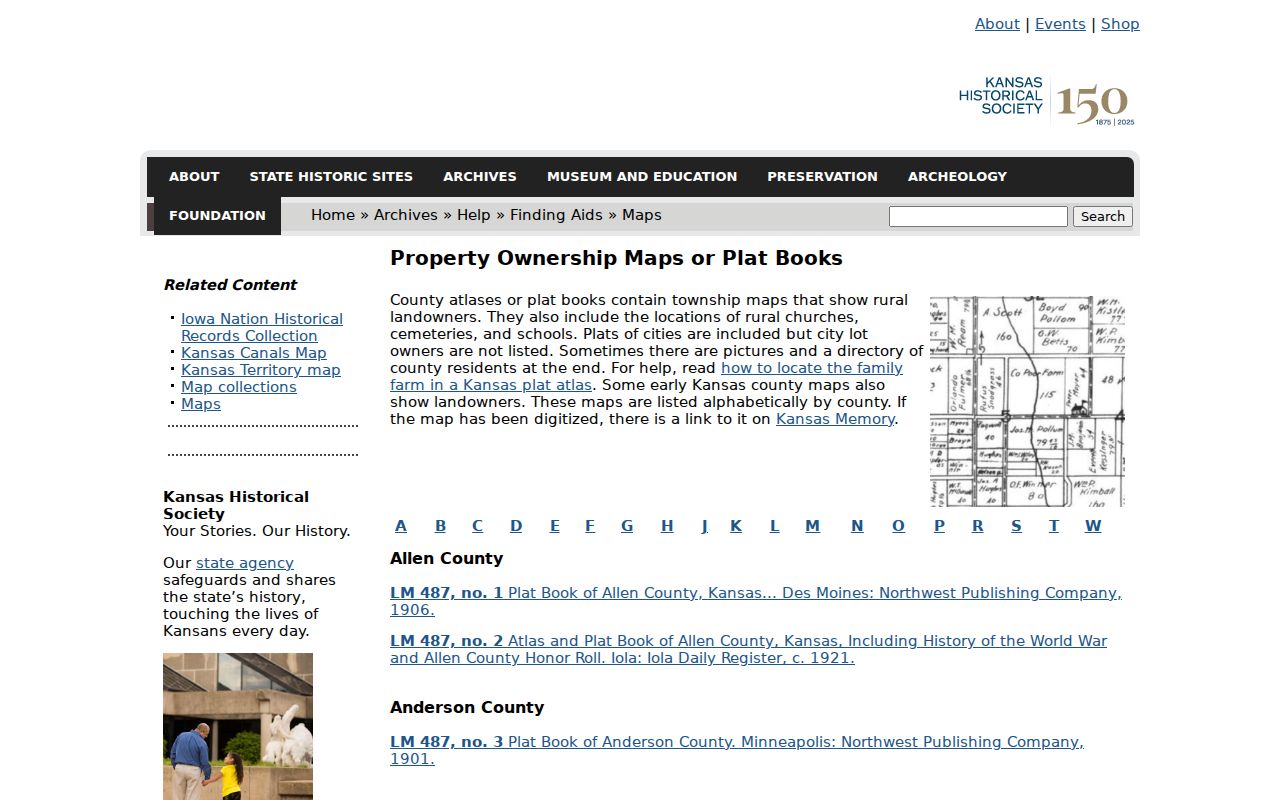
Let the atlas label sharpen your deed-book request. Proof of each transfer still comes only from the recorded instruments.
Earlier Osage Owners Need Archives
KSHS describes an Osage County archival collection spanning 1858 through 1954 with deeds, mortgages, probate, district court, and township material. County records on microfilm can be used in the research room or requested through participating libraries by interlibrary loan. Federal tract books may begin a rural chain of former property owners, but they are organized by legal land description rather than owner name.
Osage County will records survive on microfilm for 1861 through 1922. When a deceased owner disappeared from deeds, pair the will volume with the probate case, newspaper notice, and later estate conveyance. Each source supplies context. The deed recorded after the estate action supplies the next land-transfer link.
Walk the Osage County Deed Chain Backward
The Register publishes no online deed index. Contact the Register with a party name and legal description, keeping the address only as backup, and request each prior reference in turn.
- Obtain the newest deed for the exact legal description.
- Read its grantor and prior-instrument reference.
- Find that grantor's acquisition as a grantee.
- Repeat in office indexes and deed books.
- Grantor / grantee
- The conveying and receiving parties.
- Chain of title
- The linked sequence of land transfers.
- Legal description
- The durable land key when addresses change.
Search Weller County Name Variants
Osage County was organized in 1855 and renamed from Weller County in 1859. Early catalog entries and court files may therefore carry a label that no longer matches the county. The same goes for newspapers and township records. Search both county names whenever a former-owner trail reaches that era.
Township terms can narrow an archival request too. Documented names include Agency, Arvonia, Barclay, Dragoon, Elk, Fairfax, and Grant. Junction, Lincoln, Melvern, Olivet, Ridgeway, Scranton, Superior, and Valley Brook round out the list. A historic label is a clue, not proof of a modern boundary. Confirm it against the legal land description and the recorded deed book.
Use Osage Newspapers as Leads
Old newspapers hold clues deeds can miss. Probate notices, foreclosure sales, tax sales, and land announcements all carry dates. Name variants worth chasing come with them. The Kansas Historical Society newspaper database supports both title and date research. Local reels reach further than the online search. OCR misses names all the time. Try spelling variants and then inspect the page image or microfilm itself. A notice never transfers title. Use its date, party name, and legal wording to pull the court file or recorded instrument. Keep your former-owner timeline anchored in deed records. Local publications bridge the hard gaps.
Reach Beyond Osage County's Web Records
The Register's records reach back to the early 1800s. No official public deed index exists online. With no cutoff posted, that early material stays off the web, but KSHS opens research-room and interlibrary-loan routes to microfilm, along with archival records and atlas finding aids that can reconnect former property owners to the deed chain.
Lawful use. Trace former owners for house history and property diligence. Never use historical owner data to track, harass, or harm a living person.