
Compare Osage County Property Value Types
Kansas value records separate appraised value, assessed value, agricultural use value, and transaction evidence. Keep the field label and effective year with each figure, because none is a stand-in for today's market price.
| Value | What It Is | Where |
|---|---|---|
| Appraised value | County estimate of market value for most property | Appraiser parcel record |
| Assessed value | Appraised or use value multiplied by the class ratio | Assessment record |
| Agricultural use value | Productivity-based value for qualifying farm land | Appraiser and Kansas DOR rules |
| Sale consideration | A past transaction figure, when recorded | Deed or transfer record |
Kansas sets the class ratios. Residential property is assessed at 11.5 percent of appraised value, commercial real property at 25 percent, and vacant lots at 12 percent. Agricultural land is assessed at 30 percent of its use value. Know the class before comparing assessed figures across parcels.
Separate Osage Appraised and Assessed Values
Kansas starts with appraised value. It then applies a statutory ratio based on the property's class to arrive at assessed value. The assessed figure feeds the tax calculation, while the mill levy stays a separate input. For bills and appeal routes, see the Osage County property tax records page.
Two parcels with identical appraised amounts can end up with different assessed values. The class ratios simply differ between residential and commercial property. Vacant lots carry yet another ratio. Note: always note the property class and effective year beside any value being compared.
Osage Agricultural Value Uses Productivity
Qualifying Kansas farmland is not appraised on market value. It is valued from use and productivity. Then it is assessed at 30 percent of that use value. Comparing it straight across with a home site or commercial tract misleads. Soil and use context matter more than a simple per-acre sale figure.
A farm parcel can also hold land or improvements in another class. Keep every field label from the Appraiser record intact. Agricultural use value is not the price a buyer would pay for the whole tract.
Tuesday Shapes Osage Value Timing
The Appraiser parcel search updates every Tuesday. When you check an Osage County property value, save the search date, the valuation year, and the displayed class. A newer deed or a changed use can exist before the next visible update lands. Tax figures can also rest on a prior assessed value. Check that year before comparing amounts.
The portal does offer an appraised-amount range filter. That filter finds records whose stored values fall inside the bounds you choose. It does not express any market opinion.
Compare Osage Values With State Ratios
The Kansas Department of Revenue assessment reference separates market appraisal, assessed value, and agricultural use value. It is the official word on the ratios behind county valuation records. The state reference lists those categories:
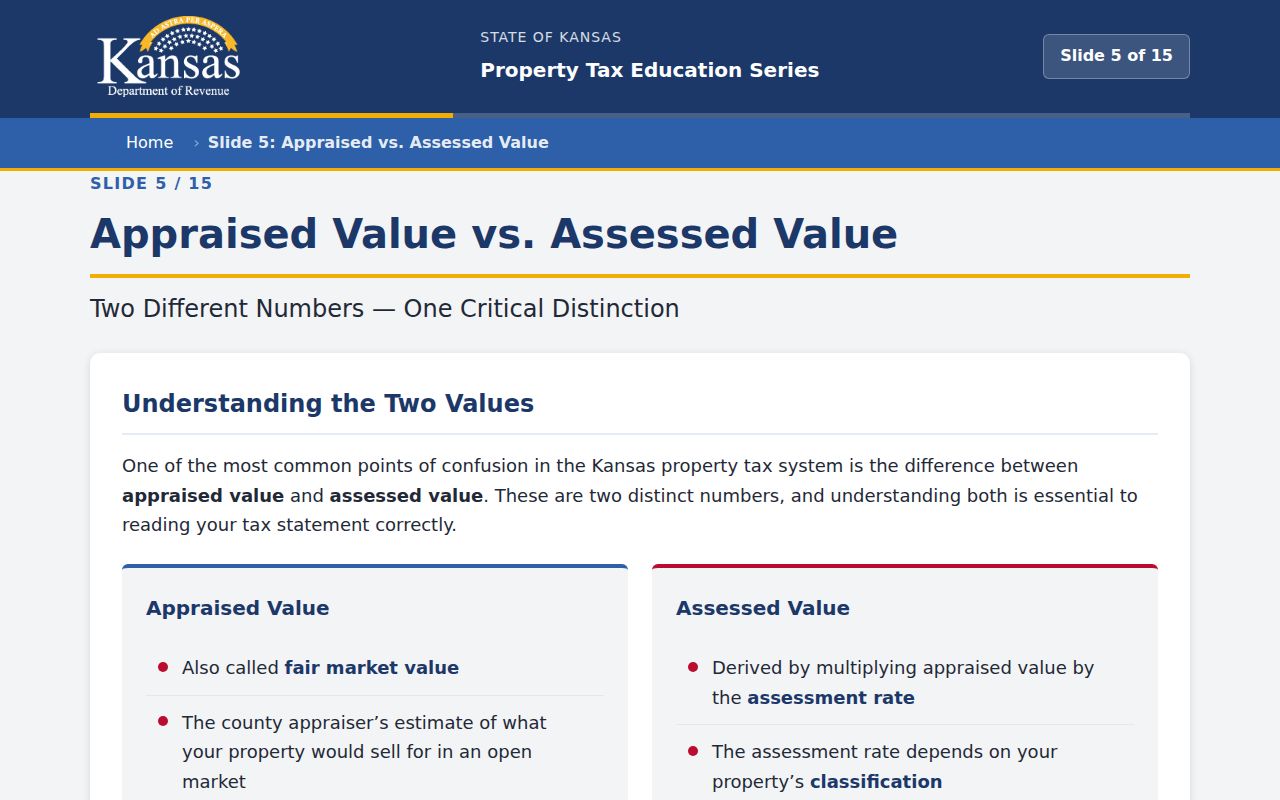
Apply each ratio only to its proper class. A ratio check can explain an assessed figure, but it cannot turn that figure into a sale estimate.
Use Sale Price as Dated Evidence
A deed or transfer record may carry consideration from a single transaction. That amount reflects its own date and terms. It can differ from appraised value. The sale involved family, an estate, multiple parcels, or unusual financing the assessment roll never mentions.
The Register of Deeds can pull an instrument with a party name and legal description. A street address helps. The office publishes no public deed index. Requests go by phone, fax, mail, email, or the Lyndon counter. Ask for the exact recorded instrument. Do not treat an assessor sale clue as complete proof.
Look Up an Osage County Assessed Value
The Appraiser search accepts an address, parcel identifiers, property class, acreage, neighborhood code, and an appraised-amount range. Save its Tuesday update note with any result.
- Find the exact parcel by address or identifier.
- Record the class, effective year, and each labeled value.
- Apply the relevant Kansas ratio only when checking the calculation.
- Keep any deed consideration separate as a dated sale fact.
- Assessed value
- The ratio product used in the tax formula.
- Appraised value
- The county's estimate for most property classes.
- Assessment ratio
- The statutory percentage applied by class.
Record an Osage Value Snapshot
A good value note records the source and the search date. It should also list the valuation year, property class, appraised value, and assessed value. Note any agricultural-use label too. Add the Parcel ID or Quick Ref ID so the figures tie to one tract. If a deed price enters the comparison, log its transaction and recording dates separately.
Countywide reports show class trends and appraisal uniformity. But they cannot set one parcel's likely sale price. Kansas ratio studies measure appraisal level and uniformity under state law. They are context for the public valuation system. They are not substitutes for the parcel record or a current private appraisal.
Explain Osage Value Differences
Two official numbers can both be right for different years or purposes. First ask what each one is: appraised, assessed, taxable, agricultural use, or sale consideration. Then compare date, property class, and parcel scope. A deed can cover several tracts. An Appraiser value belongs to a single tax parcel.
Physical changes and class changes can shift a later valuation record. The parcel search includes building, acreage, neighborhood, and class criteria. Those criteria help test whether two records describe similar property. Those fields support research, but they never make the county value a private appraisal.
Know What an Osage Assessor Value Is Not
The assessor's figure exists to run the public valuation system, nothing more. It is not a private appraisal. It is not a guaranteed offer. And it may not even match the amount recorded on a past deed. Agricultural land introduces its own wrinkle. Osage County appraises farm parcels for tax purposes on use and productivity rather than on ordinary market value.
Value vs price. An Osage County assessed value supports taxation and does not predict a selling price. Obtain a qualified appraisal for a current market opinion.